

In the year 2026, almost every company is thinking about AI in one way or another.
Lauri Raitasuo, our Lead Solutions Architect at Gapps, is one of the first team members hired for our newly founded AI & Solutions team. The team is much like a startup working inside Gapps, and the goal is to help our customers implement AI in a meaningful way. But the hot potato is: how to introduce AI solutions that create clarity rather than add complexity? Let’s hear it from Lauri.
Starting from understanding, not technology
Lauri’s role focuses on helping customers make sense of the AI space, which is still new to many companies. In practice, this often means that the first step is to understand what the customer is trying to achieve in their business, processes, or day-to-day ways of working.
“The customer understands that AI is important, but doesn’t yet know what it means for their business,” Lauri describes.
The work begins by examining how the business operates today. What does the current process look like? Where do things slow down? Where is time or effort being lost? These questions often shape the direction of the work more than any individual technology choice.
%20(1200%20x%20700%20px).png?width=1200&height=700&name=Untitled%20(1200%20x%20600%20px)%20(1200%20x%20700%20px).png)
In many cases, this initial phase takes the form of a workshop. It is a structured discussion where the customer’s way of working becomes more visible. Together, the team reviews the current state, identifies bottlenecks, and begins outlining potential improvements.
“We’re not there to present ready answers. We help to bridge the gaps between business processes and technology in collaboration with the client.”
In practice, this often leads to a clearer shared understanding before any decisions are made about AI.
When AI makes sense and when it doesn’t
One of the recurring themes in Lauri’s work is that not everything needs AI.
“Introducing AI too early can add unnecessary complexity. I encourage organizations to grow with AI organically and not rush into technology before even a light version of an AI roadmap is defined,” Lauri says.
Because of this, part of the work is also about timing. When to move forward, and when to first fix something more fundamental. These decisions often have a significant impact on the outcome.
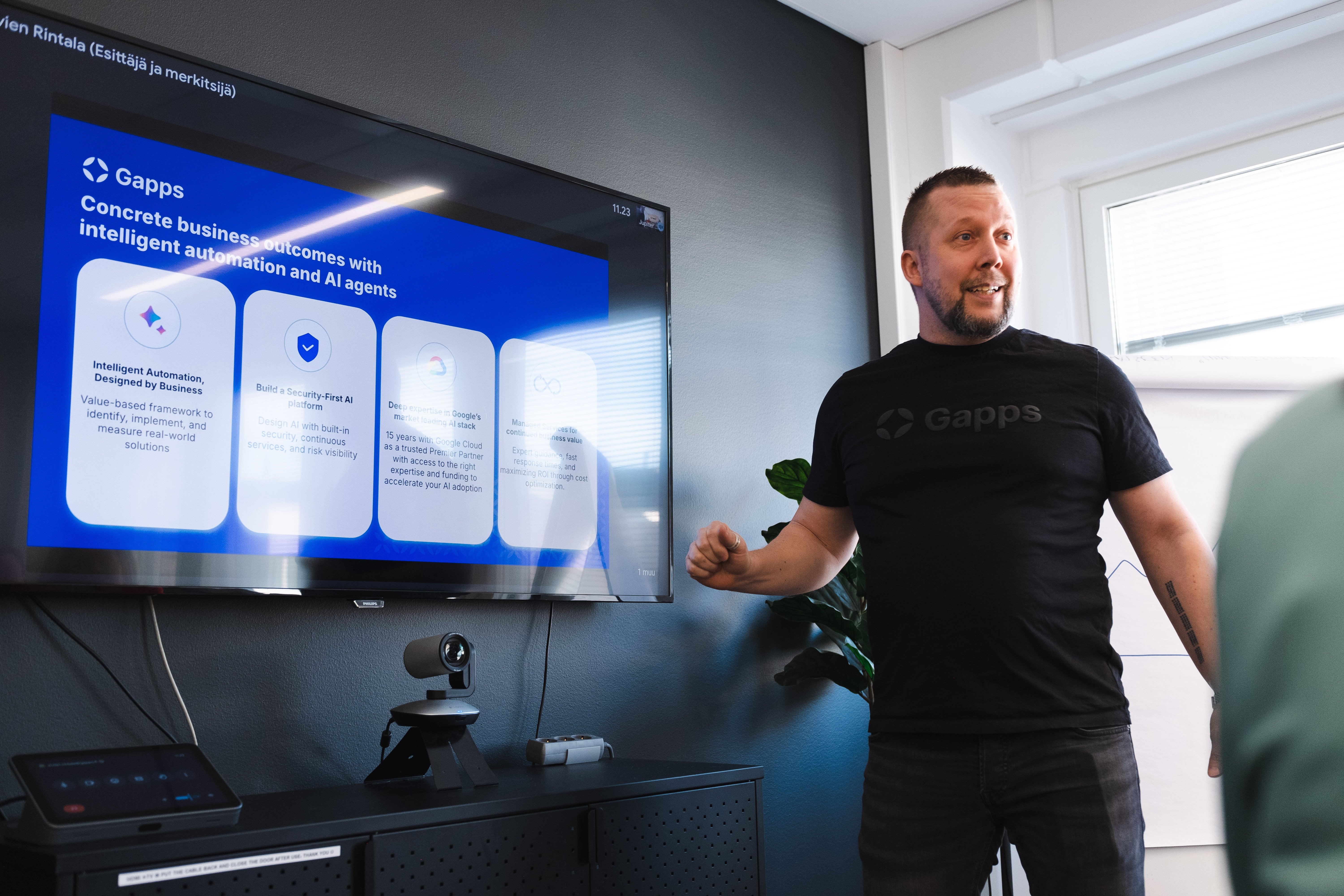
When AI is a good fit, the work moves into more concrete experimentation. Solutions are prototyped, use cases are tested with real data, and ideas are validated together with the customer.
“The best outcome is when the customer can take what we’ve built and use it as part of their everyday work,” Lauri says.
In practice, this often means keeping solutions simple enough to be usable rather than aiming for unnecessary complexity.
While many projects start with individual use cases for a customer, Gapps’ AI & Solutions team also continuously identifies opportunities for reuse and creates scalable solutions. Patterns start to emerge across multiple customers, and those can gradually be shaped into more structured services and processes.
“In practice, this often means asking what could be done more consistently and how individual solutions could evolve into something that scales better over time,” Lauri says.
Building something new inside an established company
The AI & Solutions team is still in an early phase, as evidenced by how the work is done. There is a lot of freedom, but also a high level of responsibility, as many of the ways of working are still taking shape.
“It feels a bit like building a startup inside a company that already works,” Lauri says.
At the same time, the environment differs from that of a typical startup. Gapps has an established customer base, long-term relationships, and a clear direction. AI solutions are being developed as part of the same mission the company has had for years: helping organizations work smarter with technology.

For the people working on the AI & Solutions team, this kind of role often sits at the intersection of multiple areas. It involves understanding business problems, designing solutions, and building them in practice.
“You need to understand the business side, but also be able to build things yourself,” Lauri says.
It also requires the ability to move between different levels of detail, from high-level discussions to hands-on implementation, while keeping the end goal in mind.
If you’re curious about what it’s like to build practical AI solutions in customer environments, we’re hiring an AI Solutions Sales Executive at Gapps.


