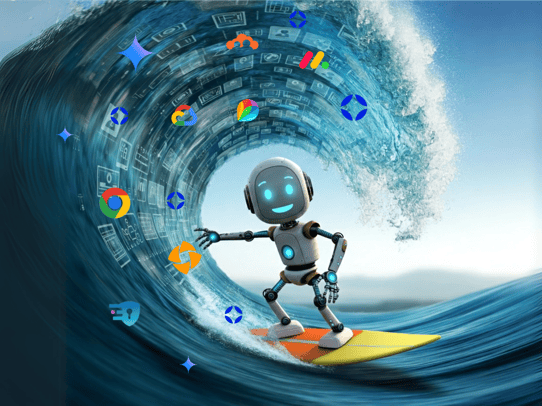
AI Agent Trends 2026: From Chatbots to Autonomous Business Ecosystems
The digital transformation landscape is undergoing a decisive shift. While much of the recent focus has been on generative AI that answers questions, the real story for 2026 will be the rise of agentic AI. These are systems that move beyond simple input-output interactions, but how do they work exactly?

What are AI Agents?
AI agents are systems that combine advanced AI intelligence with the ability to use tools and take actions on your behalf. Unlike traditional AI that might just summarize a document, an agent, on the other hand, understands the goal, creates plans, and executes multi-step tasks across different applications. All under human oversight.
This represents a fundamental leap from an "add-on" approach to an "AI-first" process. We are moving from instruction-based computing (where we tell a computer how to do something) to intent-based computing, where we simply state the desired outcome and the agent determines how to deliver it.
5 Trends Redefining Business Value in 2026
In a recent eBook, AI Agent Trends 2026 the trends we are facing this year. Here’s a quick summary of the insights:
1. Agents for Every Employee: The Human Supervisor Model
The most significant shift isn't just about efficiency; it's an employee-centric transformation. In 2026, every employee, from analysts to VPs, becomes a human supervisor of agents. Instead of performing every mundane task, their primary role is to manage a team of specialized agents grounded in the company's "ground truth"—its own internal data, customer history, and knowledge bases.
Example: The Modern Marketing Manager’s Agent Team
- Data & Analyst Agents: Monitor market trends and competitor moves 24/7, delivering a one-page insight report every morning.
- Content Agent: Drafts social posts and blog articles in the company's specific brand voice based on weekly themes.
- Creative Agent: Generates accompanying images and videos based on the marketing strategy.
- Reporting Agent: Automatically pulls weekly campaign data and analyzes it for performance summaries.
2. Agents for Every Workflow: The Digital Assembly Line
In 2026, business value grows by creating "digital assembly lines": human-guided, multi-step workflows where multiple agents run a processfrom start to finish. This is made possible by the Model Context Protocol (MCP). This standard allows agents to connect seamlessly with diverse data sources like BigQuery or Cloud SQL to take real-time actions.
For example, in telecommunications, agents can now autonomously detect network anomalies, open a field service ticket, and alert the customer—all in one integrated sequence.
3. Agents for Your Customers: Proactive Concierge Experiences
Customer service is moving from re-explaining problems to a "concierge-like" model. Because these agents are grounded in CRM and logistics data, they don't wait for a complaint.
Proactive Resolution: If a delivery van breaks down, a logistics agent can automatically reschedule the delivery, apply a service credit to the customer’s account, and notify them via text with a new time slot before the customer even realizes there is a delay.
4. Agents for Security: From Alerts to Action
As threat actors begin to use AI, agentic systems become the best tool for defense. An Agentic Security Operations Center (SOC) uses a system of task-based agents to move from simply flagging alerts to actively investigating, analyzing malware, and recommending responses in real-time. This elevates human analysts from tactical responders to strategic defenders.
5. Agents for Scale: Upskilling as the Ultimate Driver
Technology is only half the battle; the "half-life" of a technical skill is now as short as two years. To scale, organizations must invest in a holistic learning strategy built on key pillars:
- Executive Sponsor: Provides funding and high-level backing.
- Groundswell Lead: The "AI megaphone" who collects employee ideas.
- AI Accelerator: The technical expert who turns ideas into functional agentic solutions.
The Gapps View: Bridging the Gap with Intelligent Workflows
At Gapps, we believe the true power of agentic AI lies in making workflows and processes completely seamless. While agents are powerful individually, their greatest value is realized when they work across your entire organization.
We specialize in Intelligent Workflows—the cross-system automation that bridges the gap between siloed internal processes and different software platforms. Our goal is to create seamless agentic automations that ensure information and tasks flow effortlessly between functions, from finance and HR to IT and customer service.
As your partner, Gapps is here to help you set up these agentic systems, create smooth processes, and support your employees as they transition into this exciting new way of working.
>> Ready to dive deeper into the future of work? Download the full "AI Agent Trends 2026" eBook here!