

Where Do You Sit on the AI Maturity Curve?
Before writing a single line of code or deploying a new assistant, you must honestly evaluate where your organization currently stands. True operational maturity isn't just about the software you license; it’s about your company culture, your internal workflows, and your employees' capacity to adapt to new operating models.
We view AI transformation across five distinct maturity phases:
[Aware] → [Pilot / PoC] → [Active Use] → [Systematic] → [Transformed]
- Aware: You understand AI’s potential, but it hasn’t been integrated into daily workflows yet.
- Pilot / PoC: You are actively testing specific use cases or running proofs of concept in isolated pockets.
- Active Use: AI is driving specific operational functions, and you are beginning to realize and refine tangible benefits.
- Systematic: AI capability is a primary driver of your platform choices and core business models.
- Transformed: AI is seamlessly woven into the company's daily operations and overarching strategy, operating across individual, team, and infrastructure levels.
Many organizations find themselves transitioning into the "Active" phase. However, a common mistake is aiming for a "Systematic" or "Transformed" model overnight, even though the workforce is still grasping the fundamentals. A minor feature change might seem simple to a tech team, but it could represent a massive shift for another department. Never underestimate the friction a poorly planned change can cause.
The Three Most Common AI Roadblocks – and How to Avoid Them
In our work helping organizations navigate digital transformation, we repeatedly see teams stumble over the same three hurdles:
1. The "Garbage In, Garbage Out" Trap
If you don't have trustworthy, clean data backing up your Large Language Models (LLMs), your AI initiatives will fail. When an AI produces unreliable outputs, organizations are forced to implement manual verification steps and extra layers of human control. Instead of making your business smarter, you’ve accidentally created more administrative friction.
2. Siloed Development
When departments launch independent AI pilots without communicating across the hall, the organization suffers. Without mapping out technical and human dependencies across the whole company, teams miss out on the massive benefits of shared data, consolidated licensing costs, and holistic planning.
3. Confusing AI with Pure Workflow Automation
The Gapps Realism Check: Does this problem actually require AI, or do you just need smart automation logic?
In many cases, establishing standardized operating models, clear rules, and automated workflow triggers is enough to bring immediate speed and efficiency to a process. Don't use a sledgehammer where a simple, elegant gear will do.
The Power of the "Information Flow Map"
If you want to ensure your AI strategy succeeds, you have to start with upfront planning. In Finland, we have a saying: "Well-planned is half-done." In the context of digital transformation, it’s usually more than half-done.
To build a reliable operational core, you must map your workflows against three criteria:
- Criticality & Frequency: How vital is this task to daily operations, and how often is it repeated?
- Links & Dependencies: How do departments link together technically and socially?
- Known Pain Points: Are you solving a broken workflow, or optimizing a functional one?
The most valuable exercise an organization can undertake at this stage is creating an Information Flow Map. This means tracing exactly how data moves from point A to point B, and identifying where the "master data" lives.
In today’s tight economic climate, this mapping often reveals massive software bloat. By identifying where data is duplicated or siloed, businesses can consolidate their software footprint, significantly reducing platform licensing costs while simultaneously ensuring their data is clean enough to feed to an AI.
From Project Management to an AI Work Platform: The monday.com Evolution
Historically, tools like monday.com were viewed strictly through the lens of project tracking. Today, monday.com has evolved into a comprehensive Work Platform—the digital heart of your operational activity. It bridges the gap between your legacy business-critical platforms (like ERPs or specialized billing software) and your human workflows.
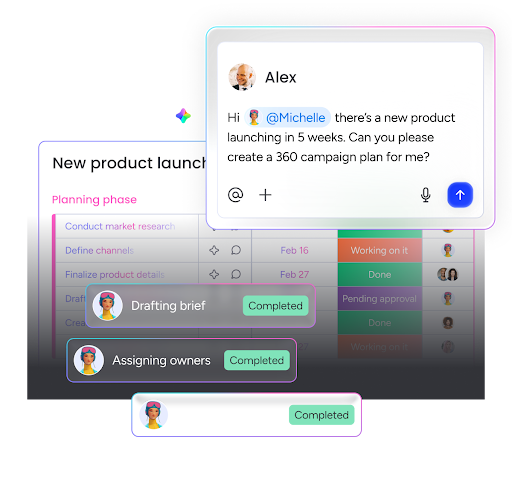
Think about a process like employee onboarding. It doesn't just touch HR. It requires IT to provision devices, line managers to schedule training, and operations to assign workspaces. An AI Work Platform breaks down these departmental silos so everyone remains entirely on the same page.
To achieve this, monday.com deploys AI across four core pillars:
|
AI Capability |
What it Does |
Real-World Operational Impact |
|
AI Blocks |
Context-aware, bite-sized components embedded in workflows. |
Automatically extracts data from invoices or tickets, generates summaries, and prioritizes tasks based on historical data. |
|
Sidekick |
Your platform-native AI copilot. |
Generates entire workflow structures, creates annual event calendars from raw text files, and builds instant data analyses. |
|
Smart Agents |
Bespoke intelligent assistants. |
Rules-based virtual assistants that handle specific, enterprise-wide background operations and compliance checks. |
|
Vibe Coding |
No-code citizen developer model. |
Allows non-technical employees to build custom, tailored internal applications just by describing what they need to the AI. |
Eliminating "Reporting for Reporting’s Sake"
The ultimate goal of deploying these capabilities is to free up human bandwidth. When AI Blocks and Sidekick handle data aggregation and reporting, your employees stop spending hours copying data into spreadsheets just to hand them to management.
Instead, they can redirect their mental energy toward actual analysis, strategy, and critical thinking: "Now that I have this data, what strategic action should our business take?"
Take the Next Step on Your Journey
True operational transformation happens phase by phase. You don't need to swallow the whole cake at once, just pick the most critical slice and start building.
We are here to help you design a digital environment that fuels your growth without losing sight of the humans running it.


